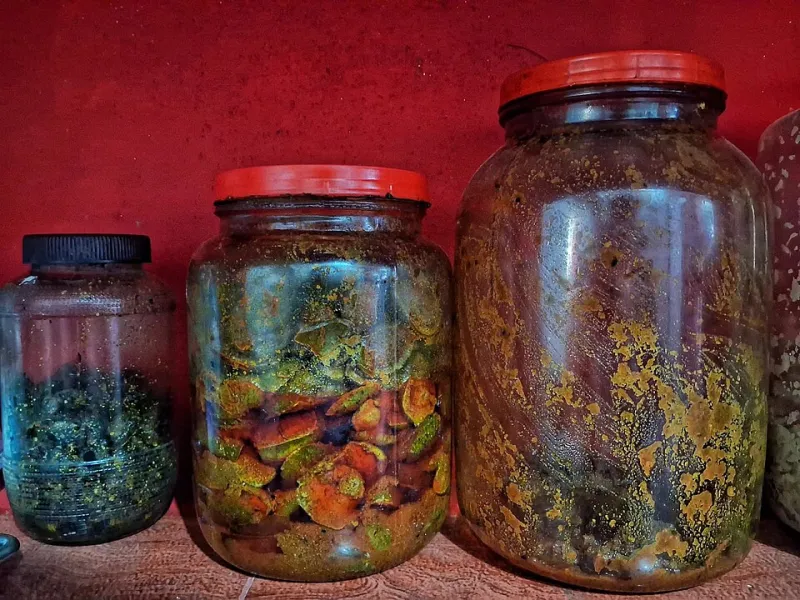
Jars Before the Frost: A Green Tomato Chutney Route Through London's November Markets

Photo: HaJunkiyada, CC BY-SA 4.0, via Wikimedia Commons
Every November the same thing happens at London markets. The growers give up waiting for the ripening and start selling their green tomatoes by the bowl — hard as golf balls, some already blushing, all of them hopeless in a salad. They sit beside carrier bags of windfall apples and shallots sold by the string, and for roughly three weekends, until the first hard frost shuts the season down, the whole lot is dirt cheap.
This is the chutney window. Below is the formula I use, the route I take through the markets to find the stuff, and how to deal with nine jars of the finished article when your kitchen is the size of a wardrobe.
The master formula (learn it, then bend it)
Chutney is a ratio, not a recipe. Get the ratio right and you can swap in whatever the market throws at you.
For every 1kg of prepared produce, use 400g sugar, 350ml vinegar and 15g salt, then spice to taste. That's it. The produce should break down roughly like this: 60% green tomatoes, 25% apple, 15% shallot or onion.
On the sugar, light muscovado gives you depth and a darker colour; plain granulated is fine and nobody has ever complained. On the vinegar, malt is the traditional choice, cider is softer, and distilled lets the spices shout — a mix of malt and cider is my usual. Never use the expensive stuff you'd put on chips.
Windfall apples bring their own pectin and their own bruises. Core and chop them, leave the skins on, cut out anything genuinely rotten. A brown patch is fine. A fur coat is not.
Salt first, sugar second
Chop the tomatoes and shallots, toss them with the salt in a colander set over a bowl, and leave them for a few hours, or overnight in the fridge. The salt pulls out a shocking amount of water, which means a shorter, safer cook and a chunkier finished texture rather than a purée. Tip the liquid away — or use it to brine a chicken, if you're that sort of cook.
For the spice, my standard build per 1kg of produce: two tablespoons of yellow mustard seeds, a thumb of ginger grated, two or three chillies, a tablespoon each of cumin and coriander seed, a few cloves, plenty of black pepper, and a star anise if there's one in the cupboard. Toast the whole seeds in the dry pan until they smell like a shop that sells incense, then add the vinegar and sugar and bring it to a boil.
Add the drained produce and simmer for 60 to 90 minutes, stirring from the bottom of the pan every ten minutes or so. Test for set by dropping a spoonful onto a cold plate, waiting a minute, and pushing a finger through it. If the channel holds and doesn't flood, it's done. Remember that chutney firms up considerably as it cools, so pull it off the heat while it still looks slightly looser than you want.
Sterilising with one shelf and no dishwasher
This is where most people give up, and there is no need.
Wash the jars in hot soapy water, rinse, and stand them upside down on a tray in an oven at 130C for fifteen minutes. Metal lids go in a pan of boiling water for five minutes. If you do have a dishwasher, a hot cycle works, but fill the jars while they're still hot — a cold jar and hot chutney is how you get cracked glass and a very long evening.
Fill to about a centimetre from the rim, wipe the thread with a damp cloth, and screw the lid on tight. Leave the jars undisturbed for 24 hours. Home chutney is acidic and sugary enough that it doesn't need a water bath; store it somewhere dark and cool and eat it within a year, then keep it in the fridge once opened. If a lid is domed, or the seal has failed, or there's mould under the lid, bin it and don't mourn.
On equipment: a Pyrex jug with a spout beats any funnel, and reused jars are entirely respectable. Caper jars, mustard jars and jam jars all work; 200-250ml is the gift-sized sweet spot, and a big 1kg jar is what you keep for yourself. Lids with a plastic lining cope with vinegar better over the long term than bare metal.
A market route for the glut
Saturday morning, start east. Ridley Road in Dalston is where you buy shallots by the bowl and whole spices at prices that feel like a mistake — bring cash and check the days before you travel. Walk or bus up to Broadway Market for growers with real windfall apples and the occasional crate of green tomatoes hiding under a table.
Borough is the reliable one for a single mixed box, but go at 8am if you want to browse, or after 4pm if you want the stallholders filling a bag for a fiver. Maltby Street and Spa Terminus suit the ambitious, and reward you with a coffee while you think about it. Brixton on a Saturday is good for apples, ginger and chillies by the handful. North End Road in Fulham does big boxes of cheap veg and is pleasantly free of fuss.
Sunday is farmers' market day: Queen's Park and Alexandra Palace both turn up good apples, though you'll pay for the privilege. Handy for a single glorious kilo when you've already got tomatoes.
Budget on £6-8 of produce. That plus store-cupboard vinegar and sugar gets you eight to ten jars — call it 70p each, before you've even printed a label.
The bit nobody warns you about
Vinegar steam will fill the flat and stay in the curtains. Open every window, run the extractor, and make chutney the day before you have people over, not the day of. Keep the heat medium — sugar scorches quietly and then all at once.
And label the jars properly: date, heat level, a note that says keep me in the dark. Chutney is at its best four to six weeks after it's made, which means a batch cooked this weekend is ready to give away at Christmas. Sharp cheddar, cold ham, a baked potato, the inside of a cheese toastie — it will find a home.