Fold, Freeze, Repeat: A November Dumpling Stash for Tiny London Freezers
There is a particular kind of November evening in London when the flat is cold, the cupboard is vague and the idea of chopping a whole dinner feels unreasonable. This is where a dumpling drawer earns its keep. Not a grand chest freezer in a utility room, obviously — just the top drawer of a rented fridge-freezer, wedged between a bag of peas and something mysterious from August.
The plan is simple: one market trip, one big filling session, and a couple of hours of folding. You end up with a stash that cooks from frozen in the time it takes to boil a kettle and find the soy sauce. It is not a precise science, and it is not meant to be. Think of it as batch cooking for people who like snacks for dinner.
Start with the cheap end of the market
For this sort of project, you want volume and flavour rather than premium cuts. A Saturday trip to a market like Ridley Road, Chapel Market or the outer edges of Borough will usually turn up bendy greens, brown mushrooms and a bag of spring onions for very little. In November 2026 the good stuff is cabbage, kale, leeks and whatever mushrooms look like they need using.
For the protein, supermarket pork mince is the practical choice for most people, but firm tofu works just as well. If you use tofu, press it for twenty minutes, crumble it, and season it more boldly than you think. A little soy, sesame oil and white pepper goes a long way. With pork, go for a fattier mince rather than lean — the filling stays juicy and doesn’t turn into a dry little pebble.
The rough ratio I use is about 500g of filling for 40–45 wrappers. That is one packet of shop-bought wrappers, which is the sensible shortcut for a first go. Making your own dough is a lovely project for another day, but this one is about getting food into the freezer before midnight.
Two fillings that behave themselves
A wet filling is the enemy of a neat dumpling. Salt your greens first. Shred cabbage or kale finely, sprinkle with salt, leave for fifteen minutes, then squeeze hard in a clean tea towel. You will be surprised how much water comes out. Do the same with grated courgette if you are using up the last of the season.
Filling one: pork, cabbage and spring onion. Brown the pork lightly with grated ginger and garlic, then cool it completely. Mix with the squeezed cabbage, sliced spring onion, a tablespoon of soy, a teaspoon of sesame oil and a pinch of sugar. Cool before folding — warm filling makes the wrappers sweaty and difficult.
Filling two: mushroom, tofu and leek. Soften sliced leeks and chopped mushrooms in a pan until their water has cooked off, then cool. Crumble in pressed tofu, add soy, a little rice vinegar and plenty of black pepper. This one is forgiving and holds together well, which makes it good for beginners.
Two folds to get you started
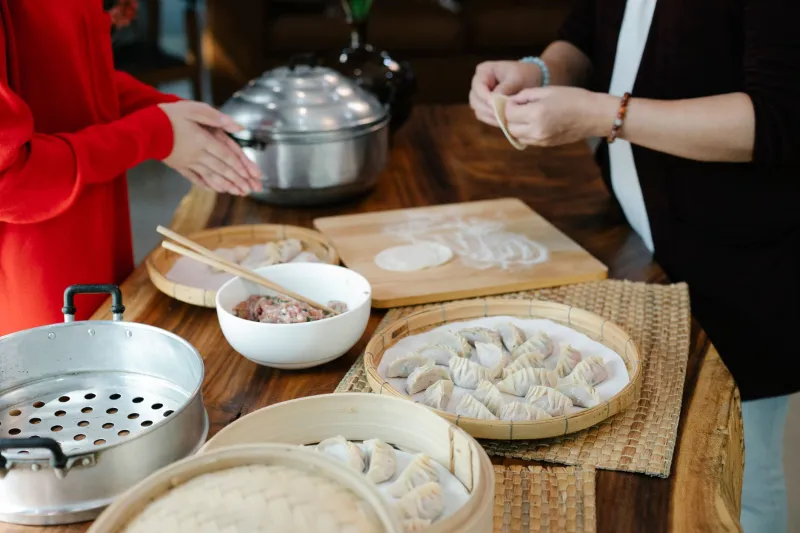
The half-moon is the easiest. Put a teaspoon of filling in the middle of a wrapper, wet the edge with a finger, fold over and press. No pleats, no drama. It looks like a little pasty and cooks perfectly well. Keep the filling modest — overstuffing is the main reason dumplings split in the pan.
The standing crescent is the next step up. Place the filling in the centre, wet the far edge, fold in half, then make three or four small pleats along one side only. Press the pleats firmly and curve the dumpling slightly. It will not look like a restaurant dumpling on the first tray. That is fine. The point is a sealed parcel, not a beauty contest.
Keep the wrappers under a damp tea towel while you work, and put finished dumplings on a tray dusted with cornflour. Do not pile them on top of each other.
Freezing when the drawer is already full
This is the real London problem. Before you start, clear a shelf or drawer and be honest about what is in there. A bag of ice that has fused into a glacier can go. So can the remains of a curry from three weeks ago that nobody is going to eat.
Freeze the dumplings first on a tray in a single layer for about an hour, then tip them into a freezer bag or tub. Squeeze out the air, label with the date and filling, and flatten the bag so it slots into gaps. If space is really tight, freeze them in stacks of five separated by baking paper. They will keep for around three months, though they rarely last that long.
A useful trick is to freeze a small “starter portion” of eight or ten dumplings separately. That is the portion you cook when you get home late and cannot face decision-making.
Cooking straight from frozen
Do not defrost them. Put a frying pan on medium heat with a tablespoon of oil, arrange the frozen dumplings flat-side down and cook for two minutes until the bases begin to colour. Add a splash of water — about 100ml — cover immediately and steam for six to eight minutes. Take the lid off, let the water cook away, and let the bottoms crisp again.
Alternatively, boil them from frozen in salted water. When they float, give them another two minutes, then scoop them out. That is the faster route. The pan-fried version is the one that feels like a proper supper, especially with a bowl of rice vinegar, soy and chilli oil on the side.
Serve with quick-pickled cucumber, a handful of greens wilted in the same pan, or simply eaten standing up by the hob. The dumpling drawer is not about impressing anyone. It is about opening the freezer on a dark Tuesday and knowing that dinner is already folded, waiting and roughly five minutes away.